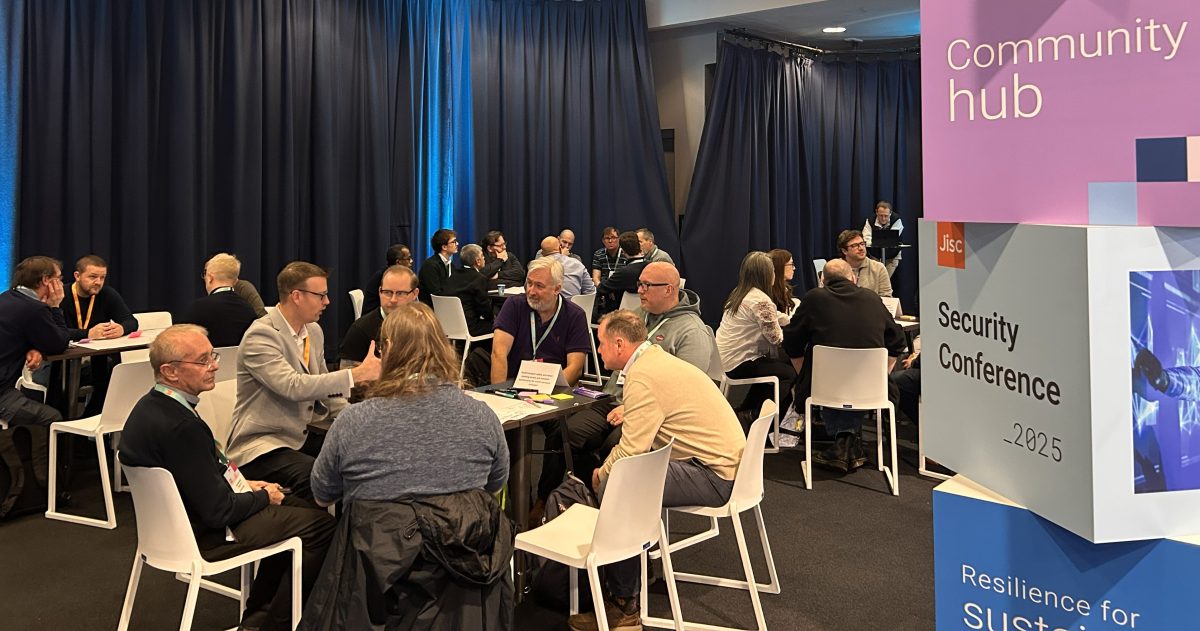
Last month marked the first time a dedicated community-focused session had been run at the Jisc security conference, introduced following the success at other Jisc events. Although I had not been involved in those previous events, the feedback provided showed they were effective. Hence, the opportunity is to have a space where the FE community can come together and explore themes more conversationally.
Why we ran the session
The FE community is diverse, representing members from all locations and sizes and at different levels of infrastructure maturity. While, their day-to-day operations are broadly the same, the way in which they are conducted is vastly different. What united everyone in the sessions was a shared desire to communicate effectively with users and to make security feel more human, relatable, and achievable.
The community style provided the perfect environment for discussions. Unlike formal presentations, it created a space where FE members could converse freely and bounce ideas off one another, exploring the problems without pressure.
The levels of engagement from everyone in the discussion were one of the best points for me. People who would not normally speak up in a structured conference setting felt comfortable contributing, and the overall conversation quickly became collaborative.
Shared problems, shared progress
We structured the sessions as a round table conversation bringing together several FE members to talk about the subject of ‘how to communicate effectively with users’, rather than presenting slides or delivering a formal talk.
To get the discussion moving, we used three simple prompts:
- Things you have tried – what has worked well, even in small ways.
- Barriers to progress – what gets in the way of good communication.
- Things to try – ideas, experiences or changes that might help others.
These starting points encouraged honest and practical conversations as people shared real examples, from things that did not work to practices that worked really well. The conversations showed that effective communication with users can aid day-to-day operations and longer-term goals. Several of the group said how these points resonated with their experiences.
What this highlighted was that communication is not just about the message itself, but is shaped by other factors, such as workload, clarity and context. When instructions are overly technical or disconnected from everyday reality, users naturally disengage. But when communications are simple, meaningful and effective. Users’ understanding of the why and wherefore improves.
Key themes from the conversation
As the discussion unfolded, several clear themes emerged, indicating substantial common ground across the sector:
1. Clear communication over complexity
A recurring theme was keeping it simple. Short, direct, and jargon-free messages are best. Overly technical explanations create confusion for less tech-savvy users.
2. Explain why
Reasoning for why things are done with users is key, whether it is enabling MFA(multi-factor authentication) or other processes. Clear guidance on the purpose of changes makes users more likely to support the adoption of new methods.
3. Consistency across channels
Several members noted that mixed messages across departments or platforms can quickly undermine trust. Consistent messages with users, WHO, WHAT, WHERE, WHEN can be a valuable communication method, with harmony in language for information, big or small.
4. Human factors matter
Time pressures, workload, and unfamiliar terminology all play a major role in how users behave. Being empathetic with users and understanding their circumstances is key to a well-run service.
Bringing it all together
By the end of the session, a clear message had emerged. While every organisation faces its own pressures and constraints, the challenges around effective communication with users are remarkably similar across the FE community. What made the discussions so valuable was the openness with which members shared what had worked for them, what had not and what they hoped to try next.
Further discussions
As the FE community looks ahead, there are many channels to continue these discussions.
Find your local FE Heads of IT regional group
Jisc community channels are also available to join.